


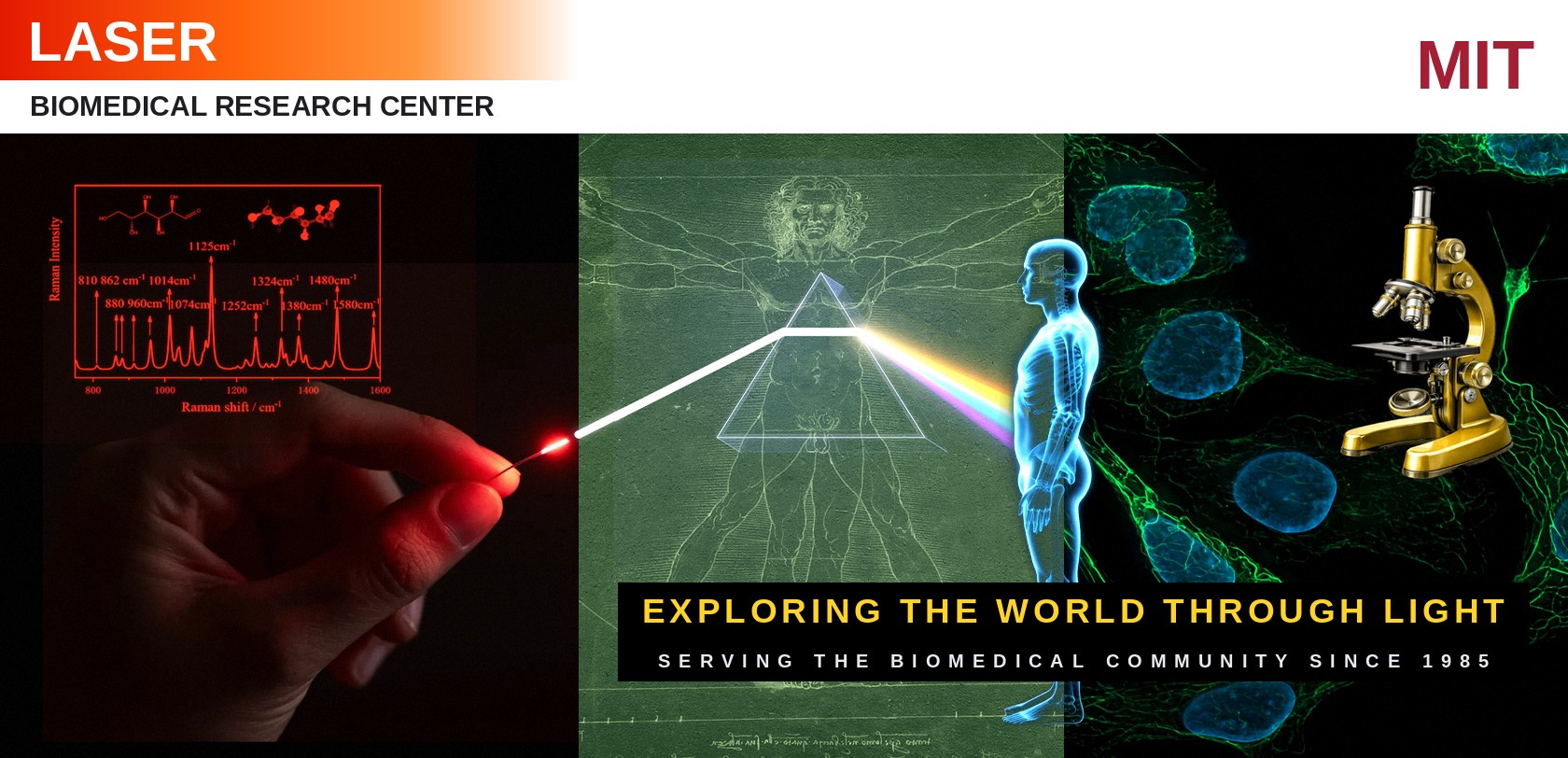
Building on MIT's strengths in engineering and the physical and biological sciences, the Laser Biomedical Research Center (LBRC) develops state-of-the-art photonic solutions for the biomedical community — light-based measurement technologies that address complex problems in biological research, pharmaceutical development, and medical diagnosis. The center was an NIH NIBIB research resource and is currently led by Professor Peter T. C. So as its director. For the history of the LBRC, see our history page.
Four technology areas, each pairing new instrument and computational development with biomedical application. Deep-learning methods are embedded throughout rather than treated separately.
Computational de-scattering (DEEP & DEEP²) and label-free deep metabolic imaging — seeing living tissue deeper and faster through the fog of scattering.
Explore →Machine-learning Raman and non-invasive transdermal sensing — from spatial molecular genomics to needle-free glucose monitoring and disease diagnosis.
Explore →Quantitative phase and interferometric microscopy — temporal-focusing phase imaging and single-frame tomographic cytometry of living cells.
Explore →Nanoprecise 3D fabrication by implosion carving and a learned digital twin of two-photon lithography — building optics and structures below the diffraction limit.
Explore →The LBRC is led by Prof. Peter T. C. So and Dr. Jeon Woong Kang, working with an interdisciplinary team of postdoctoral researchers, graduate students, and visiting scientists. Meet the team →
We often have open positions for researchers who are interested in developing cutting-edge optical instruments for biology and medicine. There are also opportunities for undergraduate students who would like to gain research experience working with us. See research opportunities →
The center maintains advanced optical microscopy, spectroscopy, and micro/nanofabrication instrumentation, available to collaborators and users of the resource. See all facilities →
In vivo cellular and tissue hyperspectral Raman imaging. 785 nm, 40× 0.95 NA, inverted.
Details →In-situ monitoring of specimen biochemistry, including non-invasive diagnosis of human disease. 830 nm, 2 mm fibre-optic probe.
Details →Label-free, large-area quantitative phase imaging based on refractive index distribution. ≈250 nm over 300 × 300 µm².
Details →Label-free three-dimensional refractive-index tomography of live cells and tissues. 110 nm lateral resolution.
Details →Patterned two-photon excitation for widefield multiphoton fluorescence imaging and three-dimensional nanofabrication. Coming online in fall 2026.
Details →The group's peer-reviewed articles and reviews, spanning 1988 to today, grouped by year. View all publications →
New papers, funding, collaborations, awards and talks from the LBRC. See all news & events →
 Sep 2026PublicationNature Aging — spatial vibrational–molecular architecture of senescence in aging and repair
 Fall 2026PeopleJeongmoo Han to join the center
 Sep 2026PeopleSu Jin Hong joins as a visiting student
 Jul 2026FundingNIH supplement for the center's SenNet senescence project
 Jun 2026FundingMOSAIC funded by the MIT Generative AI Impact Consortium
 Jun 2026PeopleAlex Matlock moves to Johns Hopkins
 Jun 2026PeopleAnthony Bae joins as a postdoctoral associate
 May 2026Talk / EventInvited presentation at DeviceTalks Boston
 May 2026PublicationNature Photonics — three-dimensional nanoprecise metastructures by implosion carving
 May 2026AwardGuest editorships in glucose monitoring
 Apr 2026CollaborationMIT-India seed fund for label-free anemia screening
 Nov 2025FundingMIT-MGB Seed Program award for AI-powered virtual histopathology
Laser Biomedical Research Center
NE47, Second Floor
500 Technology Square
Massachusetts Institute of Technology
Cambridge, MA 02139
Web: lbrc.mit.edu