
Fabricating and modeling three-dimensional nanostructures for optics — carving light-scale features into a scaffold, and teaching the design software how the printer really behaves.
Optics increasingly depends on being able to shape matter at the scale of the wavelength of light — and on trusting that a design will survive contact with the fabrication process. The lab pushes two complementary directions. The first, implosion carving (ImpCarv), is a subtractive route that patterns three-dimensional vacancies inside a swollen hydrogel and then shrinks the whole block, reaching feature sizes near 60 nm and complex, free-standing geometries that are difficult to build additively. The second, Real2Sim neural lithography, is a differentiable digital twin of two-photon printing that closes the gap between an optical design and the part actually manufactured. These are new capabilities being established now, with a first biomedical application — nanofabricated optics for high-throughput quantitative-phase cytometry — already emerging.
Two ways to command matter and light at the nanoscale — one that fabricates three-dimensional metastructures by carving and shrinking, one that models the fabrication process itself so designs come out as intended.
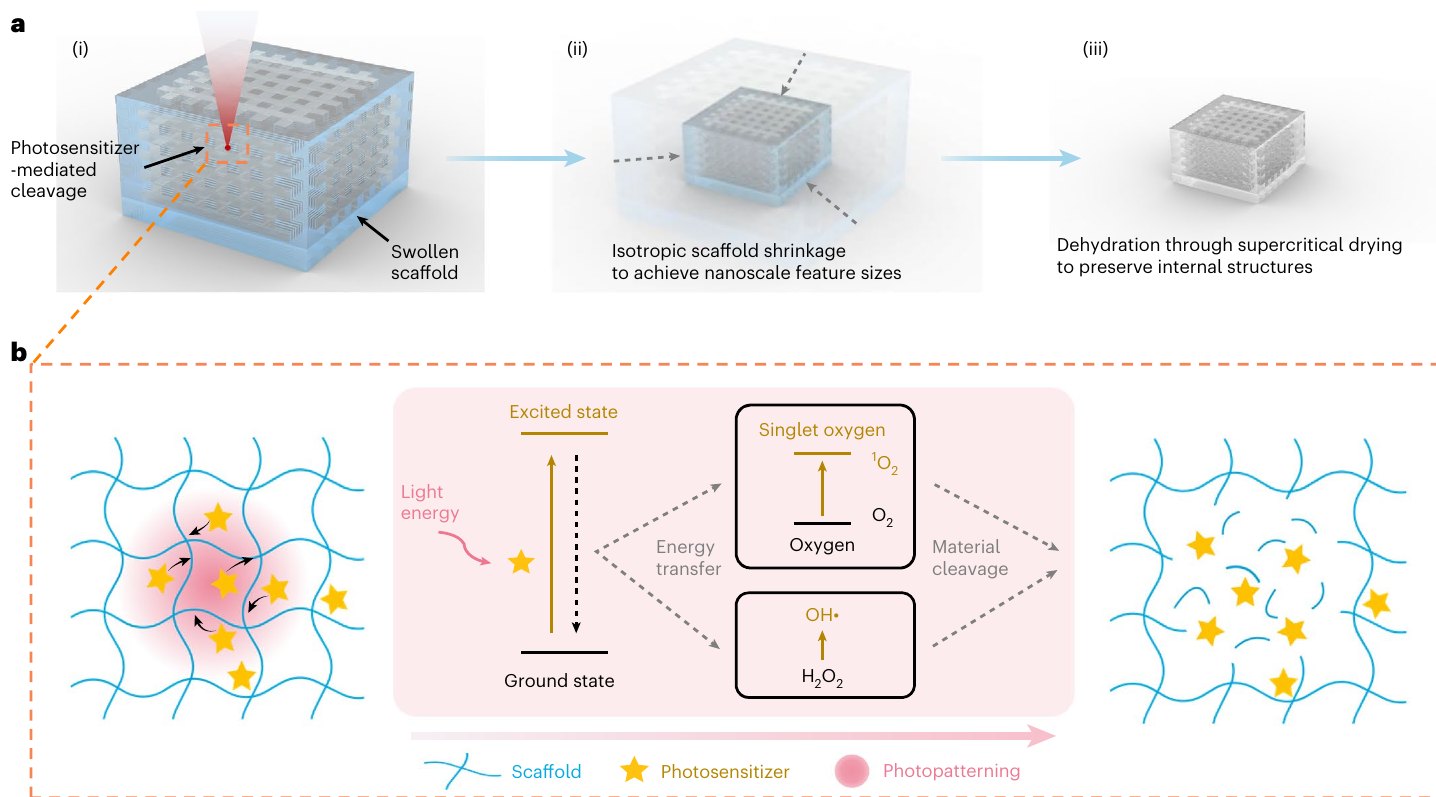
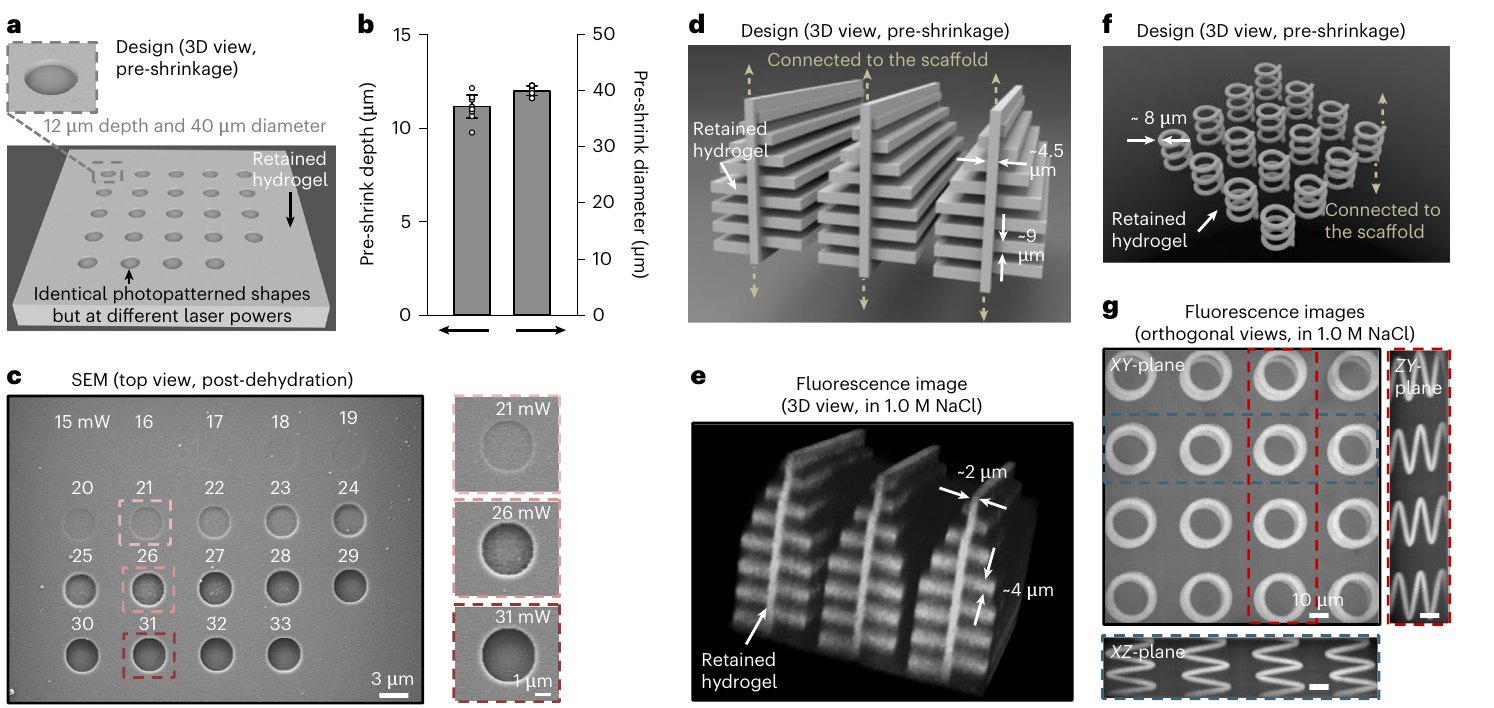
Conventional two-photon lithography builds nanostructures by adding material one voxel at a time, which limits resolution and leaves tall, thin, or enclosed shapes prone to collapse. Implosion carving inverts the idea: it removes material from a water-swollen hydrogel scaffold, then shrinks the entire block down to the nanoscale. A two-photon laser activates embedded photosensitizers only at its focus, generating reactive oxygen species — singlet oxygen and hydroxyl radicals — that cleave the hydrogel backbone and pattern three-dimensional vacancies with sub-diffraction precision. Ionic treatment then drives a more-than-tenfold isotropic shrinkage, and supercritical drying preserves the internal structure — together yielding features near 60 nm and a refractive-index contrast of about 0.5. Because every feature stays embedded in a supporting scaffold until the final step, ImpCarv can form high-aspect-ratio and free-standing geometries — such as a Morpho butterfly-wing lattice or a constant-diameter 3D helix — that additive methods struggle to produce. As a flagship demonstration, the group built a visible-light diffractive optical neural network whose ~500 nm elements classify handwritten digits under 532 nm light.
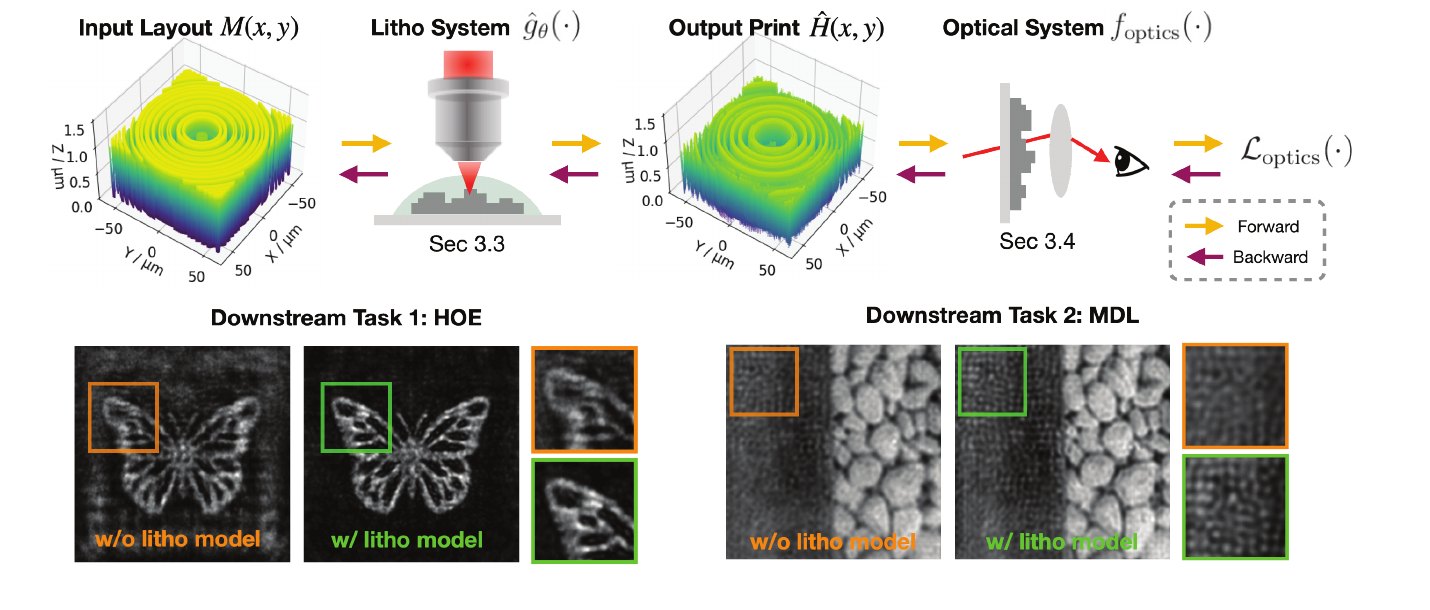
Computational optics — holograms, diffractive lenses, metasurfaces — can encode powerful functions, but a design is only as good as the part that comes off the printer. Two-photon lithography introduces shrinkage, proximity, and exposure effects that most design pipelines ignore, so fabricated optics often underperform their simulations. Real2Sim closes this design-to-manufacturing gap with a differentiable digital twin of the lithography system: a neural network trained on real atomic-force measurements of printed structures learns to predict — to within about 24 nm — how any designed layout will actually be fabricated. Because the twin is differentiable, it drops directly into the optical design loop as a manufacturability-aware regularizer, so the optimizer designs for the part that will be built rather than an idealized one. The result is a fabrication-in-the-loop pipeline that co-optimizes an optical element together with the way it is printed — a fully differentiable bridge from computational design to two-photon manufacturing.
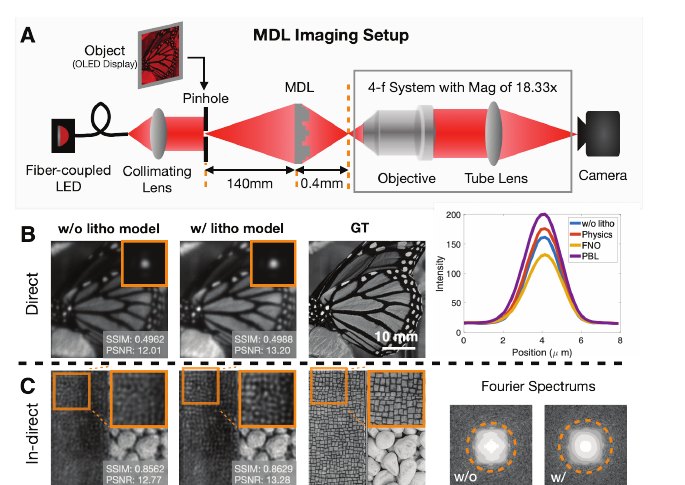
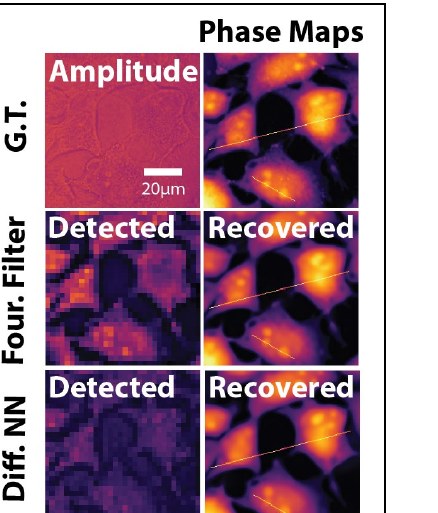
An emerging application of the lab's nanofabrication capability — using nanofabricated optics to break the throughput limits of biomedical imaging.