
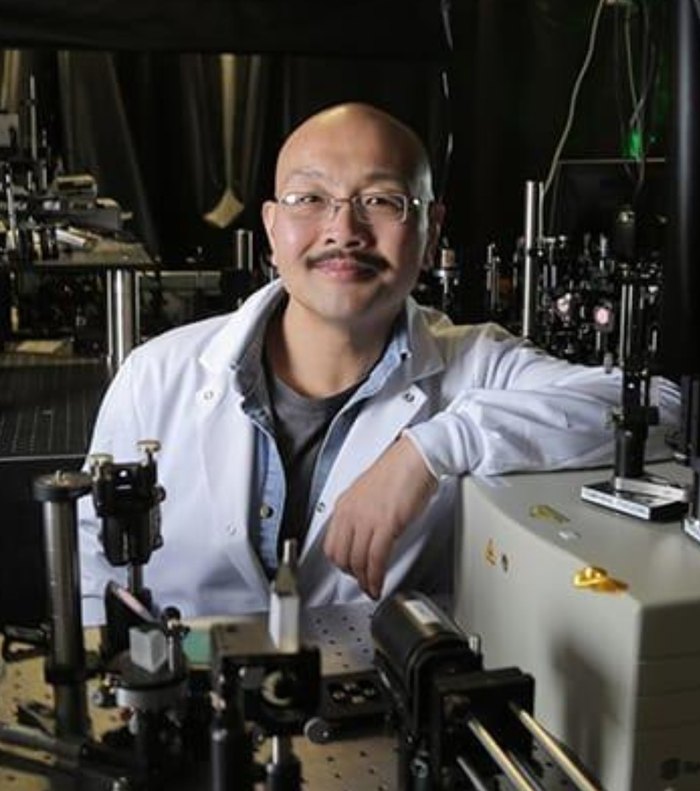
Departments of Mechanical Engineering & Biological Engineering, Massachusetts Institute of Technology
My area of expertise covers optics, microscopy, spectroscopy, bioengineering, and biophysics. I was trained in biophysics in the laboratories of Drs. Sol Gruner and Erramilli Shyamsunder at Princeton University. Afterwards, I worked as a postdoctoral associate and the microscopy user coordinator at the Laboratory for Fluorescence Dynamics under Dr. Enrico Gratton. After my postdoctoral training, I joined the departments of mechanical engineering and biological engineering as a dual faculty at MIT, providing excellent connections to expertise in both bioinstrumentation and biomedical science.
We established the Bioinstrumentation Engineering Analysis and Microscopy (BEAM) laboratory in 1996 with the goal of creating novel optical imaging, manipulation, and fabrication technologies on the microscopic level in order to advance biological sciences and to improve medical practices. We believe that many advances in biology and medicine are driven by the availability of new instrumentation and technologies. Our laboratory has pioneered many optical microscopy and spectroscopy techniques, and the development of these novel instruments and techniques allows us to tackle a diverse set of biomedical problems. Currently, my laboratory works on a broad range of biomedical research; a sampling includes studying neuronal plasticity, investigating mechanotransduction processes, developing image-informatics approaches to study liver fibrosis and nerve regeneration, and constructing endomicroscopes for non-invasive cancer diagnosis. Our work has been published in over 200 peer-reviewed publications.
In terms of administrative experience, I was the program co-chair of the Computational System Biology program of the Singapore-MIT Alliance and the associate chair of the BIOSYM program in the Singapore-MIT Alliance for Science and Technology; both programs involved 20–30 individual PIs with over 100 researchers across MIT and Singapore. I served as Director of the MIT Laser Biomedical Research Center (LBRC) from 2011, one of the longest-running NIH P41 research bioinstrumentation resources, which sunset in 2023 after more than three decades of operation. Today, we continue LBRC technology development in fluorescence, Raman, and quantitative phase imaging and spectroscopy, and our team works actively in the dissemination of cutting-edge technologies and education methodologies.